
For pathway, youth employment and education partnership organisations
Help students arrive ready for the opportunity.
Lumora gives young people aged 16 and over a truthful resume diagnosis, a targeted application pack and interview practice before a careers or employer conversation. It strengthens the work of local teams. It does not replace it.
- 10 students
- 14 days from activation
- No cost to the organisation, school or student during the pilot
- No card, contract or automatic billing
- Nothing invented
- For students aged 16+ and recent school leavers
Lumora is an independent Australian product. Nothing on this page is endorsed, sponsored by or affiliated with any network, school or employer that may have passed it on to you.

Where Lumora fits
One stage of a process your team already runs.
Lumora sits between the opportunity your team finds and the conversation your staff have. It handles the repetitive first pass, so the human time goes where only a human can help.
- 01Your team
Your team identifies the opportunity
A placement, a school-based apprenticeship, a part-time role, an interview a local employer has offered. The relationship and the judgement are yours, and Lumora has no part in them.
- 02Lumora
Lumora prepares the student
The student gets a truthful diagnosis of their resume, a rewrite built only from what they have actually done, a complete application pack for that specific role, and interview practice with a debrief.
- 03Your team
Your staff coach and review
Suitability, personal barriers, whether this is genuinely the right opportunity, and whether the student is ready for it. Lumora cannot see any of that and does not try to.
- 04Your team
The student approaches the employer
Better prepared, with something usable in hand, and able to talk about their own experience. The employer conversation is still theirs to have.
What Lumora is not
- A placement service
- A case-management platform
- A replacement for careers staff
- A promise of interviews or employment
- An auto-apply tool
Lumora does not contact employers, does not submit applications, and cannot see whether a student got an interview. Careers staff keep every judgement that matters.
What students receive
The actual product, on actual screens.
Every image below is a real Lumora screen, captured from the working product. The student in them is invented, and no participant, student or customer appears anywhere on this page.
01 See what is holding them back
A score, and the reason behind it.
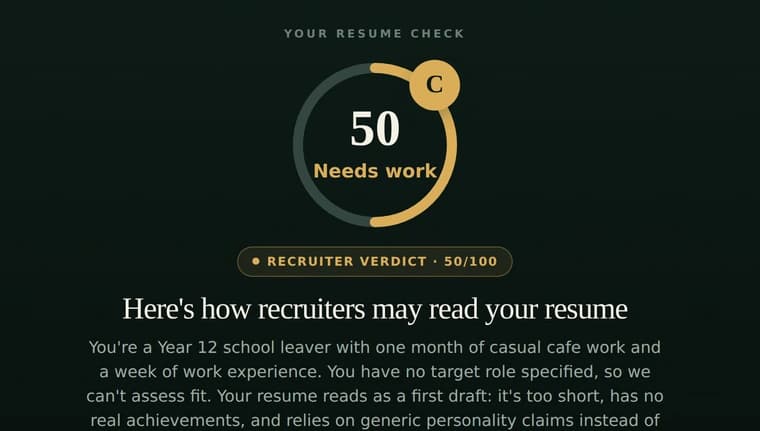
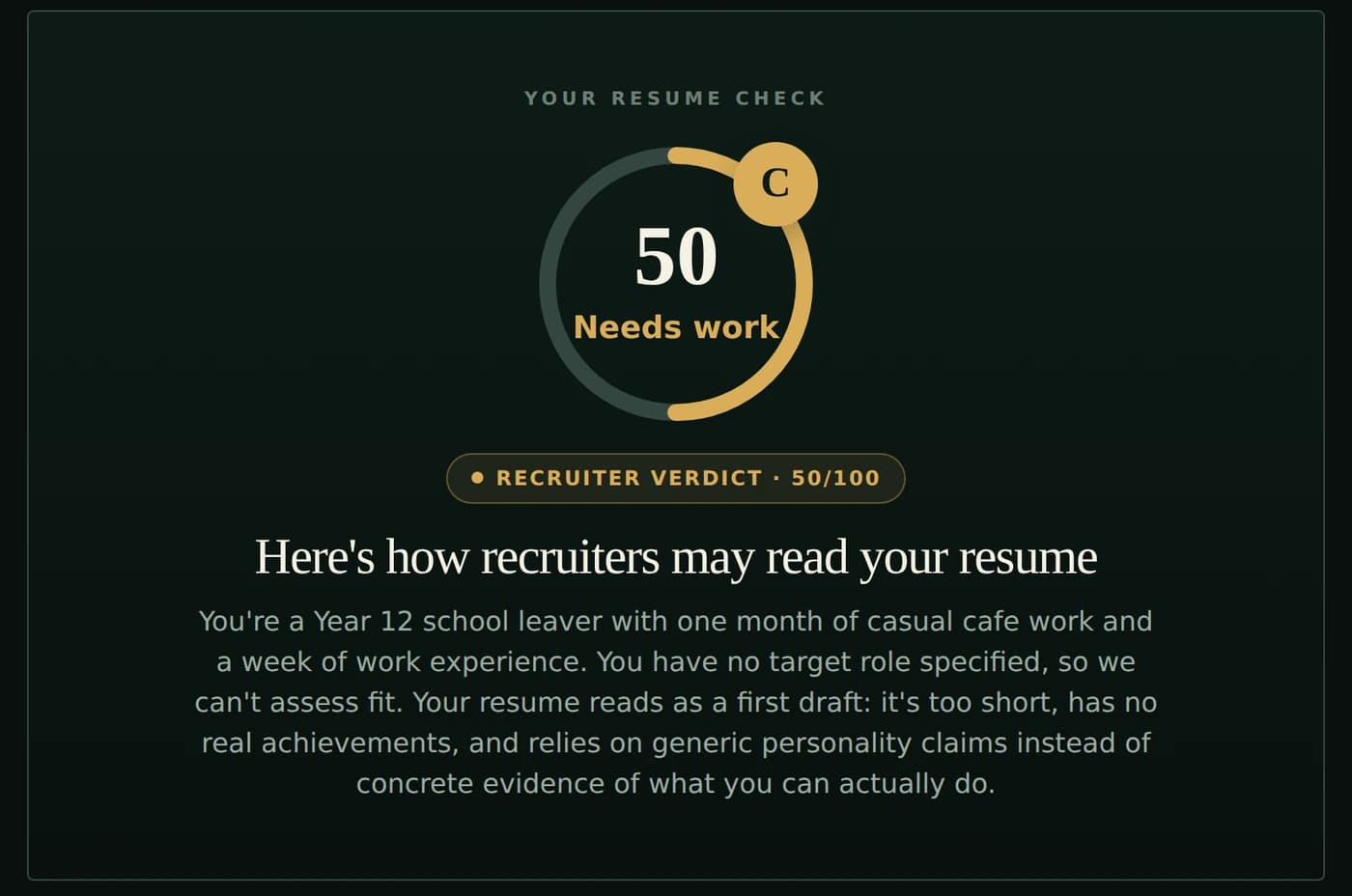
The student uploads or pastes a resume and gets a score out of 100 with a plain-English explanation of how a recruiter is likely to read it. No account, no card, no payment for this step.
- For the student
- They find out what is actually wrong instead of guessing why nobody is replying.
- For your organisation
- The first, most repetitive conversation is already had before your staff sit down with them.
Fictional Year 12 school leaver. This is the product's real output on that resume, not a selected best result.
02 Stronger, without inventing anything
The same experience, said properly.
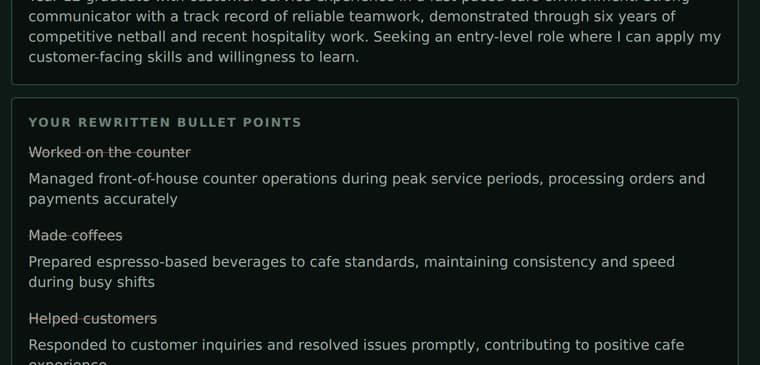
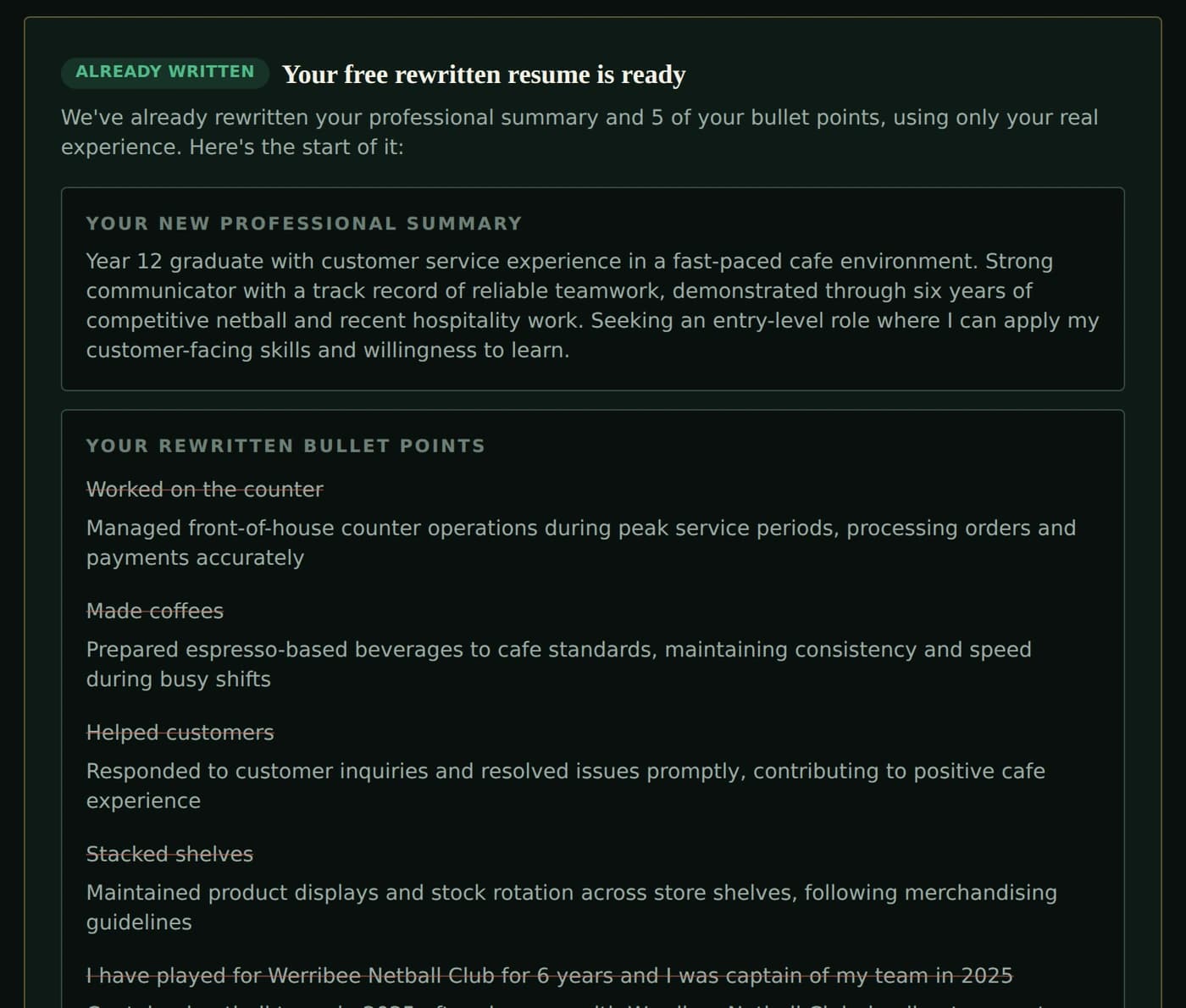
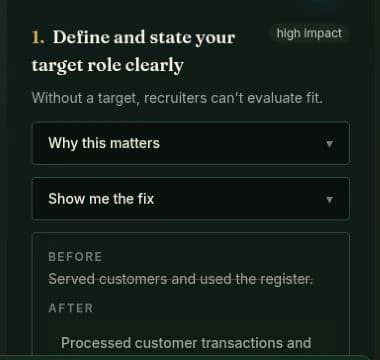
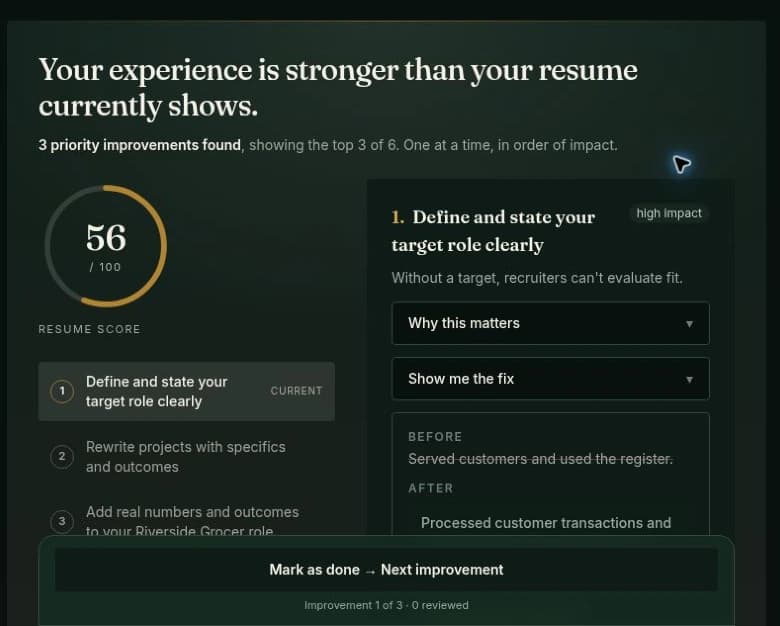
Lumora rewrites the summary and the weakest bullet points using only what the student has actually done. The original line stays on screen next to the rewrite, struck through, so the student can see exactly what changed.
- For the student
- They learn how to describe their own work, which is a skill they keep after they close the tab.
- For your organisation
- Nothing is fabricated. A teacher or careers adviser can check every line against what the student told you.
03 One thing at a time
A prioritised list, not a wall of advice.
Improvements are ordered by impact and shown one at a time, each with why it matters and what the fixed version looks like. A student who only does the first one is still measurably better off.
- For the student
- A clear next action instead of forty pieces of generic advice.
- For your organisation
- Students arrive at your appointment having already done the mechanical work, so the conversation can start further forward.
04 Turn a target into a route
Where they are, where they want to be, and the gap.
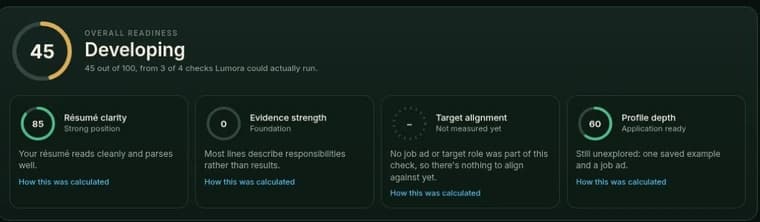
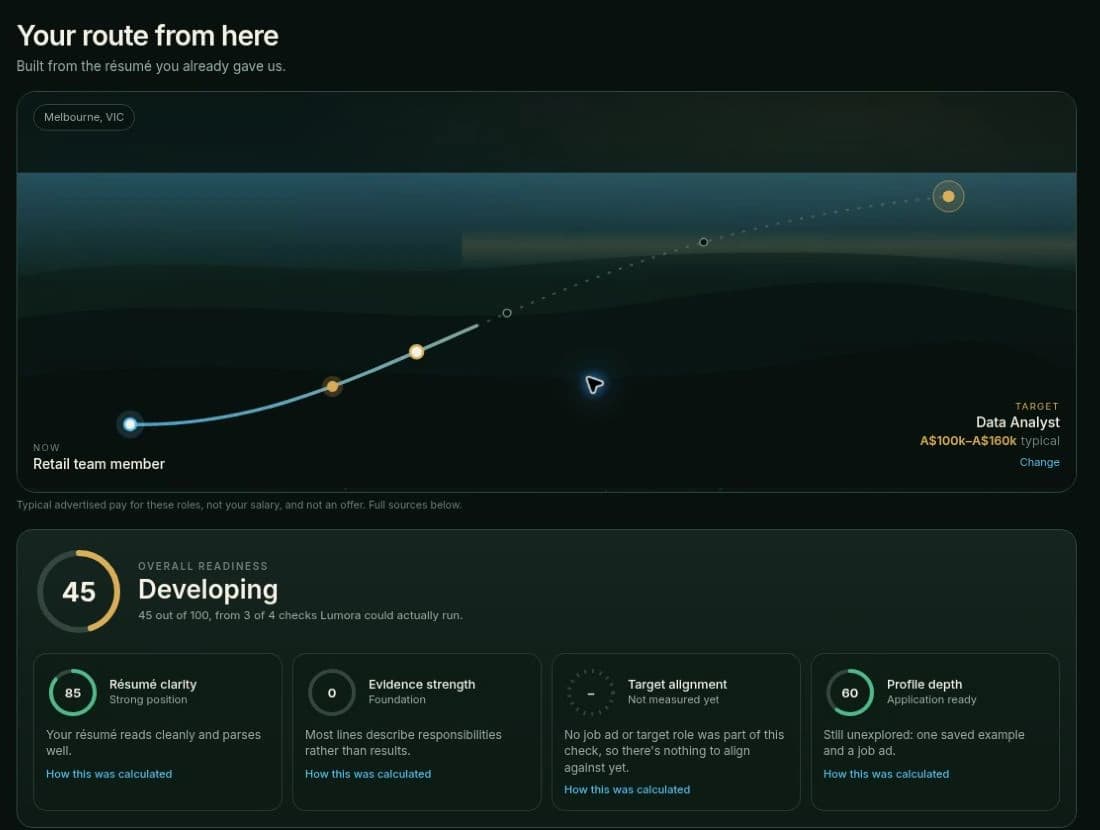
Career HQ shows the role a student is in now, the role they are aiming at, indicative advertised pay for both, and a readiness breakdown that separates resume clarity, evidence strength, target alignment and profile depth. The Evidence Vault is where a student banks real examples as they get them.
- For the student
- A direction they can describe out loud, and a named next move rather than generic encouragement.
- For your organisation
- A concrete starting point for a careers conversation, in the student's own words and evidence.
Pay figures are typical advertised ranges for those roles, labelled as such. They are not a salary offer and not a prediction.
05 Something usable, not just advice
A finished resume, in a template they chose.
The student picks a design and gets a properly formatted resume they can download and send. During a pilot this is funded by the organisation credit, so the student is never shown a price or asked to pay.
- For the student
- Something they can attach to an application today.
- For your organisation
- The output is the student's own, not a house template that makes every applicant from your cohort look identical.
06 The part most tools hide
Every stronger line stays honest.
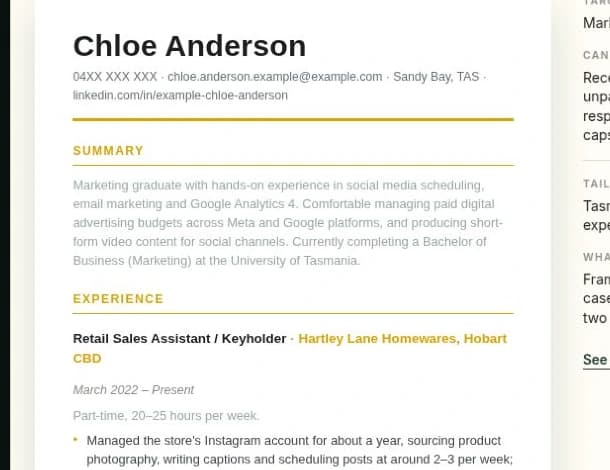
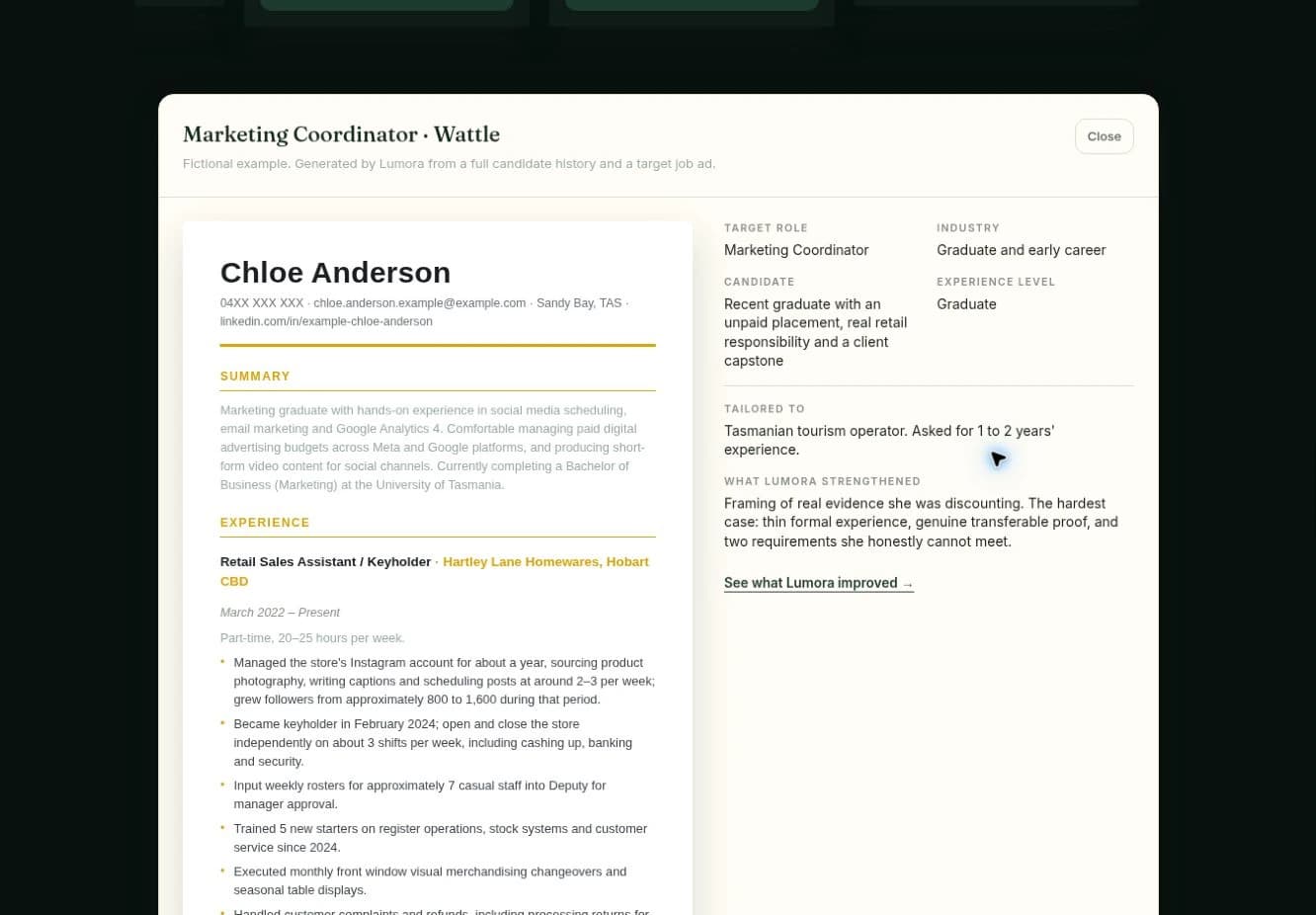
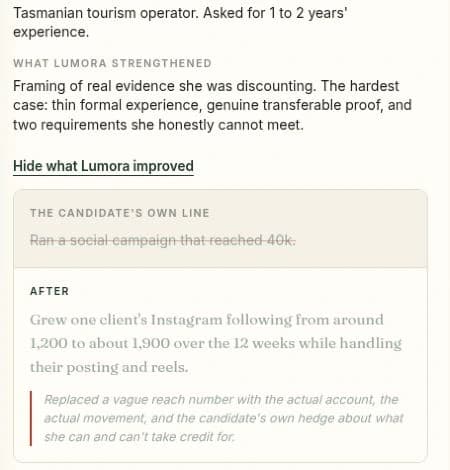
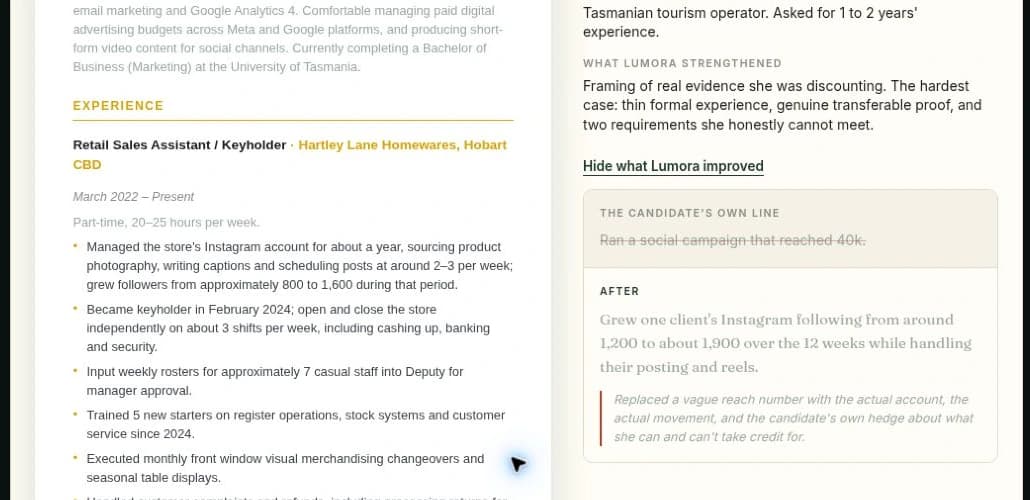
For each change, Lumora shows the student's own original line, the rewrite, and why it changed. Where the resume does not support a requirement, it says so and asks the student for a real example instead of writing one.
- For the student
- They can defend every line in the interview, because every line is theirs.
- For your organisation
- This is the answer to the question your staff will ask first, which is whether this is a machine writing lies for young people.
07 Hear the verdict · beta
A recruiter briefing on their own resume, out loud.
About a minute of spoken, personalised assessment sitting at the top of the student’s report: what stands out, what is weakening it, and what to fix first. There is a full transcript for anyone who cannot or would rather not listen. It is the shortest route we have found to a student actually taking the diagnosis in, because a paragraph gets skimmed and a voice does not.
Nothing to set up and no microphone needed. Headphones are enough.
08 Practise the moment · beta
An interview that asks, listens, and then tells them the truth.
A separate feature, and a much bigger ask of the student. The AI voice recruiter asks role-specific questions out loud, the student answers out loud, and afterwards it debriefs what they actually said: whether the example was relevant, whether there was a real result in it, and where the answer trailed off. The feedback is about the substance of the answer, not about how polished the student sounded, which matters for a young person who is nervous rather than unprepared.
This one needs a working microphone and somewhere the student is willing to speak out loud. Both spoken features are in beta and currently work best in Chrome and Edge, and both are worth checking on the devices your students will actually use before a cohort relies on them.

The pilot
10 students. 14 days. Nothing to sign.
10 students
Enough to see a pattern, small enough for your team to actually run.
14 days
Counted from the day your organisation presses start, not from the day you apply.
A$0
No cost to your organisation, the school or the student during the pilot.
- 01
You apply
Business contact details only. We do not ask for student names, case notes or documents, and you should not send them.
- 02
It is approved
Applications from an organisation email address are approved automatically. A personal mailbox gets a reply from a person instead.
- 03
You press start
Nothing begins until your organisation chooses to begin. The 14 days start at that moment, so nothing is burning while you organise your cohort.
- 04
Students use your link
Your organisation gets one link. The first 10 students who sign up through it are funded, see no prices and are never asked to pay.
- 05
It pauses
At day 14, pilot access pauses. Your organisation decides what happens next. Nothing is deleted, and students keep their accounts and everything Lumora wrote for them.
There is no card, no Stripe account, no contract and no automatic conversion at any point in a pilot. There is nothing to cancel, because nothing has started.
What you will actually learn
A short report of things we genuinely counted.
You do not wait until the end to find out how it is going. From the moment you press start, your own page shows how many places are in use, how far the cohort has got and how many days are left. At the end we review it with you properly. Every number is something the product counted rather than something we estimated, and none of it is about an individual student.
How many students started, and how many finished
Unique students who used a place, and how many completed a resume diagnosis. Counted by person, so a student who comes back does not use a second place.
What they actually produced
Completed application packs, recruiter briefings played, and interview practice sessions finished. Each counted separately, because they are three different features and one of them is a much bigger ask than the others. A count of finished work, not of logins.
How many of them genuinely used it
A single meaningful-use figure: students who completed a diagnosis and then produced something from it. Claiming a place is never counted as success, and the definition is printed next to the number rather than kept in a methodology note.
Whether the resume moved
Before and after resume score where the same student ran a check twice, so the change is comparable rather than asserted. Shown as a median, and it says how many students it is based on. If nobody ran a second check, it says that instead of showing a zero.
What the students said
One optional question to the student about usefulness and whether they feel more prepared. Ratings only, never a comment box, because free text in a group of ten identifies whoever wrote it. Optional means some students will not answer, and the report says how many were asked as well as how many did.
What the report will never contain
- Interviews offered or attended
- Job placements or employment outcomes
- Staff time saved
- Anything about an individual student
Results are reported for the cohort, never for a named student. Your organisation cannot see a student's resume, diagnosis, score or documents, and the pilot does not give your staff a login that could.

Straight answers
Including the awkward ones.
Where is student data stored?In the United States, not in Australia.
Lumora is Australian-built and Australian-run, but our database, authentication and file storage provider hosts this project in a United States region. Lumora is not Australian-hosted today, and we would rather you read that here than find it in a questionnaire.
Australian data residency is on the list of things a network-wide deployment would need. It is not something we have done, and we will not say we have.
What accreditations does Lumora hold?None. No ISO, no IRAP, no Right Fit for Risk, and not on any panel.
Lumora holds no ISO certification, no IRAP assessment and no Right Fit for Risk accreditation, and it is not on any government panel. It is a small Australian product.
For a free pilot with ten students that is usually not the question. For a network-wide paid deployment it may well be the blocking one, and it is better raised now than after somebody has committed to it.
Can staff see a student's resume or results?No.
There is deliberately no organisation-facing view of a participant's documents, diagnosis or score. The pilot funds a student's access; it does not create a window into their work. Your organisation can see that a place was used and which feature it was used on, which is what the credit count is made of.
How old do students have to be?16 and over.
Lumora's terms require users to be at least 16, so a pilot is senior students and recent school leavers. Supporting under-16 students properly would need verified parental consent, stricter retention rules and a safeguarding path that does not exist yet, and we are not going to quietly stretch the age instead.
Does Lumora invent experience to fill gaps?No, and it says so out loud.
Lumora never invents degrees, licences, tickets, jobs, achievements, employment dates, metrics or certifications. Where a student's resume does not show evidence for something a role asks for, it says so plainly and asks the student for a real example instead of writing one.
The student reviews every word before it goes anywhere.
What happens to student data when the pilot ends?Access pauses. Nothing is deleted.
At day 14 the pilot completes: pilot access pauses and unused credits are revoked. Student accounts and everything Lumora wrote for them remain, and are the student's own. Deletion is a manual process a student or your organisation can start by email.
Is any of this sold, shared or used for advertising?No resume content leaves Lumora for advertising.
Resume text, job ad text, student names and application content are never sent to advertising or analytics platforms. We do not sell resume content. Payment card details are handled entirely by Stripe and never reach Lumora's servers.
The full technical position, including subprocessors, encryption, access boundaries and the accreditations we do not hold, is written out on the data handling and procurement page. The privacy policy and terms are the binding documents.
Who built it
Built from real Australian work experience.
Elvis D'silva
Founder, Lumora
Built by Elvis D'silva, who has worked from entry-level through leadership roles across Coca-Cola Europacific Partners, Asahi Beverages, SLB, Synergy and iiNet. That is where the product's view of hiring comes from: how real Australian workplaces actually read an application, and what ordinary people struggle to say about themselves on paper.





Company names and logos are the property of their owners. They do not endorse, sponsor or partner with Lumora.
Contact: support@lumoraapply.com
Lumora is Australian-built and run from Australia. Participant data is currently stored in the United States, not in Australia.

If it works
Straightforward organisation plans.
Nothing below applies during a pilot, and nothing starts on its own. This is here because a CEO who likes the pilot will ask what it costs afterwards, and the honest answer is published rather than negotiated.
Organisation 25
A$299
including GST, per month
or A$2,990 including GST per year. Two months free, billed annually.
25 participant credits each month.
Most popular
Organisation 50
A$499
including GST, per month
or A$4,990 including GST per year. Two months free, billed annually.
50 participant credits each month.
Best value
Organisation 150
A$999
including GST, per month
or A$9,990 including GST per year. Two months free, billed annually.
150 participant credits each month.
Credits refresh each month and do not roll over. A one-off top-up of 10 credits is A$99 including GST, and is never automatic. More than 150 students a month, or need an invoice or a purchase order? Email support@lumoraapply.com and a person will answer.
Full plan detail and checkout is on the organisation plans page. The pilot is still the recommended first step.

Start a pilot
Find out whether it helps your young people.
Your organisation runs the pilot. Schools and students are not asked for anything, are not shown prices and are never asked to pay.
Apply for the free 14-day student pilot
Business contact details only. Please do not send us anything about a student: no names, no case notes, no documents.
10 students. 14 days from the day you press start. No card, no contract, no automatic billing.
Running an employment services or community organisation rather than an education one? The same pilot is described for that context on the employment providers page, and for careers teams on the schools page.